
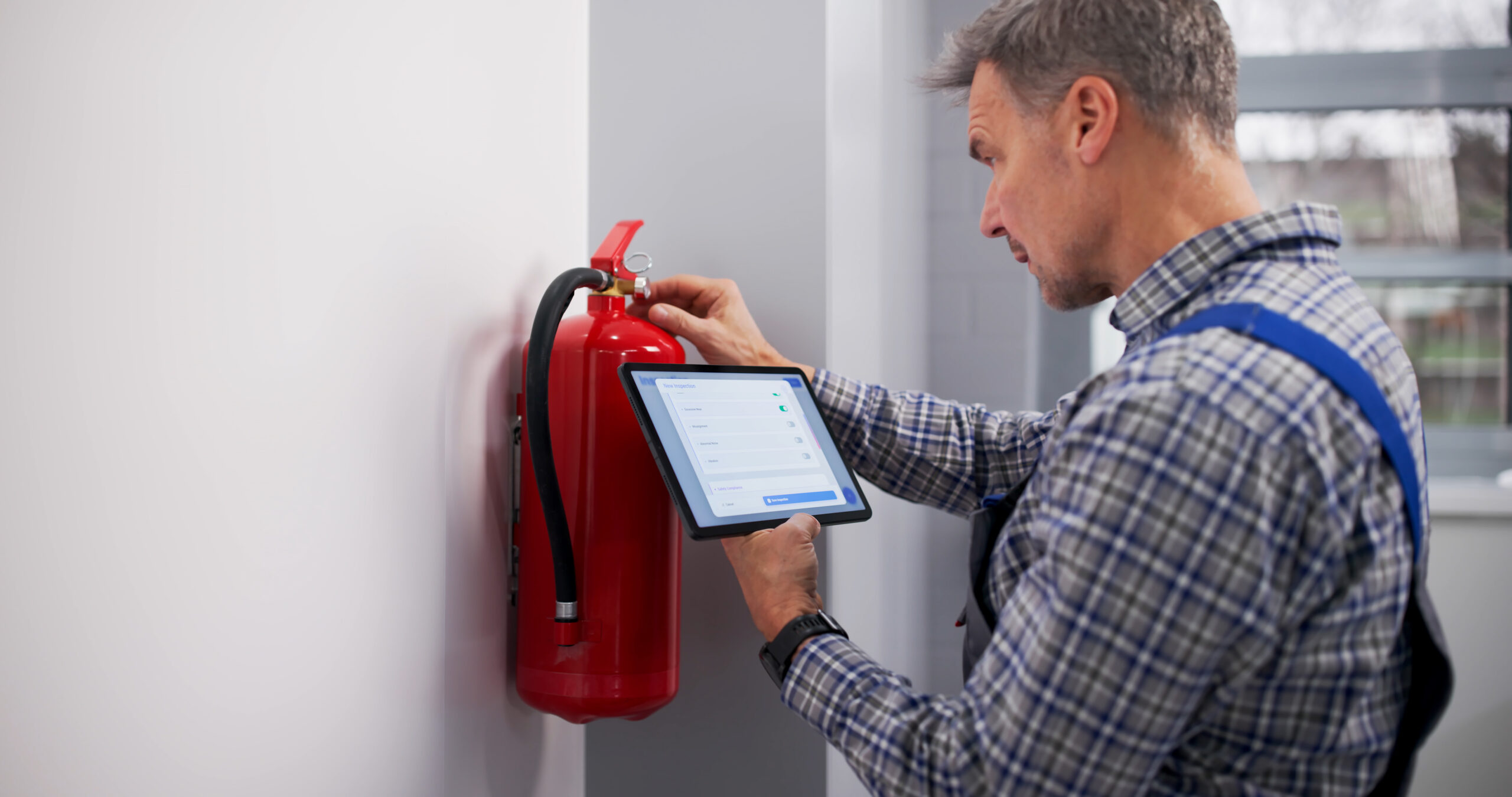
Find out how often fire extinguishers need to be serviced, who is responsible for it, and what happens during the inspection. Read now!
The most important points in brief
Are you responsible for maintaining fire extinguishers in your company and want to know what the actual regulations are? This guide will tell you:
- How often a fire extinguisher needs to be inspected and what regulations govern this.
- Who is allowed to carry out the maintenance and what exactly happens during the process.
- How to recognize an expired inspection sticker and what that means for your insurance coverage.
- How connectavo, as maintenance software, automatically keeps track of inspection dates for fire extinguishers and other equipment requiring inspection.
Why fire extinguishers need to be serviced
In Germany, companies with even just one employee are required to have fire extinguishers. As an employer, you are responsible for ensuring that sufficient fire extinguishers are available; the exact number is determined by the risk assessment of the specific workplace. Fire extinguishers are used to combat small and incipient fires and should be usable by anyone without special training. To ensure they function properly in the event of a fire, a fire extinguisher must be ready for use at all times, which requires regular maintenance and inspection.
As maintenance software, connectavo helps you keep track of these inspection dates, along with the maintenance plan and checklists for your other equipment. Fire extinguisher maintenance follows the same principles as the maintenance of other equipment requiring inspection: fixed deadlines, documented results, and a clearly designated person responsible.
These regulations govern the maintenance of fire extinguishers.
Fire extinguishers in the commercial sector are subject to several standards and regulations that every company should be aware of:
- Technical rules for workplaces (ASR) A2.2: “Measures against fires”, regulates, among other things, the number, marking and maintenance of fire extinguishers in workplaces.
- DIN EN 3: specifies basic requirements for portable fire extinguishers, including labeling and approval.
- DIN 14406-4: the central standard for the maintenance of portable fire extinguishers, now effectively legally binding due to numerous court rulings.
- TRBS 1203: Technical rule for operational safety, specifies the requirements for persons qualified to perform testing.
- DGUV Regulation 1: “Principles of Prevention”, concerns the general organization of occupational safety.
- The Industrial Safety Ordinance (BetrSichV) also applies to permanent pressure fire extinguishers, as these are considered pressure vessels.
For the actual maintenance, DIN 14406-4 is the most important standard. It contains detailed specifications regarding the procedure, scope, and documentation of the inspection.
Request a demo!
How often does a fire extinguisher need to be serviced?
According to DIN 14406-4 and DIN EN 3, the fire protection and safety functionality of a fire extinguisher must be checked at least every two years. If this deadline is exceeded, the fire extinguisher is no longer considered fully operational, and insurance coverage may be voided in the event of damage. In specific environmental conditions, such as heavy soiling or corrosion, the inspection intervals may be shortened even further. These inspection intervals apply equally to different types of fire extinguishers, regardless of their purchase price.
Additional deadlines apply to permanently pressurized fire extinguishers due to the Pressure Vessel Ordinance:
- The pressure vessel must be inspected every 10 years.
- An internal review every 5 years
- an external strength test after 10 years
If a fire extinguisher is used, or even briefly activated, it must be serviced and repaired immediately afterwards. Indications that a fire extinguisher has been used include, for example, a missing safety pin, a missing seal, or a missing pressure gauge.
Rechargeable and stored-pressure fire extinguishers: Differences in maintenance
Portable fire extinguishers are divided into two types, which also differ in terms of maintenance:
- Rechargeable fire extinguishers (also called pressurized fire extinguishers): The extinguishing agent and propellant are housed in separate containers; the extinguisher is only pressurized when needed. While the initial purchase is more expensive, regular maintenance is cheaper. The total lifespan is approximately 25 years.
- Stored-pressure fire extinguishers (also called stored-pressure fire extinguishers): The extinguishing agent and propellant gas are contained together in a single, permanently pressurized container. Therefore, they are subject to pressure vessel regulations, which include the additional inspection intervals mentioned above. Their total service life is approximately 20 years.
Both types of fire extinguishers are available with different extinguishing agents such as water, foam, or powder, depending on the respective fire classes. Which extinguishing agent and which type of extinguisher are suitable depends on the location and the fire hazards present there.
Who is authorized to maintain fire extinguishers?
Fire extinguisher maintenance may only be carried out by a qualified person who is authorized to do so in writing. The basic requirements for these qualified persons are defined in DIN 14406-4 and further specified in TRBS 1203. In practice, qualified persons are usually employees of manufacturing companies or independent testing services.
Unauthorized inspection by laypersons is not permitted. However, as the operator, you can regularly perform a visual inspection of the equipment yourself: Look for rust spots, leaking fluid from the valve, damage to the condition or other defects, and keep track of the inspection sticker and the next inspection date. You should refrain from oiling or greasing the equipment.
This happens during maintenance by a qualified person.
DIN 14406-4 prescribes both fire protection and safety inspections for fire extinguisher maintenance. These inspections include checking the condition, seals, pressure, and extinguishing agent of the device, replacing worn parts as needed, and evaluating overall functionality. Replacing worn parts and inspecting seals are integral components of every maintenance procedure.
After completing the inspection, the qualified expert affixes a maintenance certificate, usually in the form of an inspection sticker. This typically contains:
- Date of maintenance and due date of the next inspection
- Information on internal control
- Information on recurring inspections according to the Industrial Safety Ordinance
- Name and address of the expert or the commissioned institution
In addition, every fire extinguisher must be marked according to DIN EN 3 with five fields of text, including name, extinguishing agent, operating instructions, suitable fire classes and manufacturer information.
Why expired inspection deadlines become a problem in practice
A recurring misunderstanding in practice: When purchasing a new fire extinguisher, for example from a hardware store, often only the year of manufacture is indicated, but not a regular inspection date. This regularly leads to confusion in companies about when the two-year inspection period actually begins, and whether a new fire extinguisher even needs an inspection sticker immediately.
Similar uncertainties arise when fire extinguishers are distributed across multiple buildings or locations. Without a central overview, it's easy to lose track of which extinguisher was last inspected and when. An expired or damaged inspection sticker is often only noticed when it's too late, for example, during an official inspection or in an actual emergency. Without valid maintenance documentation, the fire extinguisher is considered uninspected; this is not only a compliance issue but can also jeopardize insurance coverage.
Keep digital track of fire extinguisher maintenance
Instead of keeping track of individual inspection stickers or maintaining a separate Excel spreadsheet, fire extinguisher maintenance can be managed in connectavo just like any other equipment requiring inspection. You enter each fire extinguisher with its location, type, last inspection date, and the next due date, including automatic reminders before the two-year period expires.
The principle can be directly applied to other systems requiring inspection: from documentation in the inspection report to other tasks related to building management, such as in hotels, real estate or public buildings.
Never miss fire extinguisher inspection dates again
Frequently Asked Questions (FAQ)
Generally, every two years, as specified in DIN 14406-4 and DIN EN 3. Permanent pressure fire extinguishers additionally require a pressure vessel inspection every 10 years, an internal inspection every 5 years, and an external strength test after 10 years.
Only a qualified person with written authorization, usually an employee of a manufacturer or testing service, may perform the inspection. The requirements are regulated in DIN 14406-4 and TRBS 1203. Unauthorized inspection by laypersons is not permitted.
An external visual inspection: Check for rust spots, leaking fluid from the valve, damage, and a valid inspection sticker. The actual maintenance should only be carried out by a qualified person.
Especially ASR A2.2, DIN EN 3, DIN 14406-4, TRBS 1203, DGUV Regulation 1 and, in the case of permanent pressure extinguishers, the Industrial Safety Ordinance.
Since new fire extinguishers often only have a manufacturing year instead of an inspection date, this frequently leads to confusion in practice. If in doubt, do not rely on the manufacturing year, but have the date of the first required inspection determined and documented by a qualified person or based on the manufacturer's specifications.
The fire extinguisher is then no longer considered fully functional. In the event of damage, this can jeopardize insurance coverage and also raise questions of liability.