
Learn what the TPM concept is all about, its eight pillars, and why its implementation so often fails in practice. Read now!
The most important points in brief
Are you considering whether Total Productive Maintenance is worthwhile for your company and where to best begin? This guide will tell you:
- How TPM as an approach brings production and maintenance together.
- The eight pillars that support the TPM concept and what each contributes to.
- Why implementation in practice so often fails due to a lack of data or management commitment.
- How connectavo, as maintenance software, digitally supports planned maintenance as one of the TPM pillars.
Was ist Total Productive Maintenance (TPM)?
Total Productive Maintenance, or TPM for short, is a holistic approach to the maintenance and continuous improvement of machinery and equipment. The goal is to achieve the highest possible Overall Equipment Effectiveness (OEE), through the systematic prevention of failures, downtime, and quality losses. Unlike purely reactive maintenance concepts, TPM involves all employees, from machine operators to management, thus overcoming the traditional separation between production and maintenance. Instead of viewing maintenance as merely a reaction to failures, TPM makes it an integral part of all operational processes.
As maintenance software, connectavo particularly supports the planned maintenance pillar by centralizing maintenance schedules, responsibilities, and documentation. TPM can thus be well classified as one of several maintenance approaches that focus on prevention rather than reaction, complemented by the organizational framework of the eight pillars. These eight pillars form the basis for a structured method that addresses losses systematically rather than randomly.
The 8 pillars of the TPM concept
TPM is based on a structured framework of eight pillars that cover technical, organizational, and human aspects:
| column | Focus | Goal |
|---|---|---|
| Planned maintenance | Proactive, condition-based maintenance by the maintenance department | Avoiding unplanned downtime |
| Autonomous maintenance | Involving operators in simple cleaning, testing and lubrication tasks | Early detection of wear |
| Continuous improvement | Systematic elimination of loss types by interdisciplinary teams | Maximizing efficiency |
| Quality management | Ensuring stable processes and root cause analysis in case of errors | Reduction of scrap and rework |
| Start-up management | Consideration of TPM goals already during the development and procurement of new equipment | Maintenance-friendly plant design |
| Education and training | Qualifying employees to solve problems independently | Closing skills gaps |
| TPM in Administration | Transfer of TPM principles to supporting areas | Reducing administrative losses |
| Occupational safety and environmental protection | Creating safe, sustainable working conditions | Accident prevention |
Each of these pillars contributes to one or more factors of overall equipment effectiveness (OEE): availability, performance, and quality. Planned and autonomous maintenance are often considered the two pillars with the greatest direct impact because they have the most immediate effect on downtime and short stops. Typical maintenance tasks performed by operators include simple inspections, cleaning, and lubrication, which often achieve more in daily practice than complex testing programs. Internationally, a distinction is often made between planned maintenance and autonomous maintenance.
Request a demo!
TPM and OEE: How are the two concepts related?
Overall Equipment Effectiveness (OEE) reveals where losses occur in production, but it doesn't eliminate them automatically. Total Productive Maintenance (TPM) is the methodology that addresses precisely this issue. Each of the six major loss categories included in the OEE calculation can be assigned to at least one TPM pillar:
- Plant failures and unplanned downtimes: addressed through planned maintenance.
- Setup and installation times, as well as idle time and short downtimes: addressed through autonomous maintenance and continuous improvement.
- Start-up losses and quality losses: addressed through start-up management and quality management.
Without reliable OEE measurement, TPM remains largely blind in practice: Without key performance indicators, it's difficult to demonstrate which measures are actually effective and which types of losses are truly worth addressing. At its core, it always comes down to the same principle: Making waste in processes visible and eliminating it step by step so that individual losses don't lead to permanent downtime.
What are the advantages of Total Productive Maintenance?
A consistently implemented TPM concept has an impact on both productivity and employee motivation:
- Increased plant availability: Fewer unplanned downtimes through systematic, planned maintenance.
- Productivity increase: Better use of existing production facilities instead of additional investments.
- Employee participation: Operators take responsibility for their equipment and identify more strongly with the company.
- Quality improvement: Fewer errors and rework through early root cause analysis instead of pure final inspection.
- Cost reduction: In the long term, less downtime and more efficient production processes.
- Improved workplace safety: Clean, well-maintained machines significantly reduce the risk of accidents in the workplace.
Maintenance thus transforms from a cost center into an active lever for quality and efficiency.
Why Total Productive Maintenance often fails in practice
TPM has been documented in theory for decades, but regularly fails in implementation due to the same recurring problems.
TPM is most often misunderstood as a purely maintenance-related project: only the maintenance department "does TPM," while operators and production are not truly involved. The traditional separation of "production operates, maintenance repairs" persists, even though TPM is specifically designed to overcome this separation.
A second, often underestimated problem is the lack of a reliable data foundation. If TPM measures are implemented without systematically recording plant availability and the causes of downtime, the effect is difficult to demonstrate. This jeopardizes the legitimacy of the entire project, because without visible improvement, TPM quickly loses management support. Digital maintenance processes help to make recurring malfunctions visible in the first place, before they develop into major failures.
Thirdly, the methodology is often prioritized over the result: the eight pillars are worked through like a checklist, without any real connection to the actual types of losses incurred by the respective investment. The reverse approach is more sensible: first identify the largest losses and only then selectively activate the pillars that address these losses.
Another typical pitfall is the over-bureaucratization of autonomous maintenance: endless, text-heavy checklists that operators simply tick off blindly instead of actually using them for the early detection of wear. Successful TPM relies instead on simple, visual standards that can be checked in seconds, rather than bureaucratic forms.
If TPM is consistently implemented, waste in processes decreases noticeably: less downtime, more stable quality, and maintenance processes that no longer just react to failures, but prevent them from the outset.
Making TPM measures measurable
Implementing TPM: Here's how to proceed step by step
TPM implementation rarely succeeds using a scattershot approach, but rather through a structured pilot project:
- Preparation and management commitment: TPM is a cultural shift, not just a maintenance project. Top management must define goals, allocate time for training and cleaning, and appoint a TPM coordinator.
- Selecting a pilot plant: A bottleneck plant is well suited as a starting point to restore the machine's baseline condition and make initial successes visible.
- Establish autonomous maintenance: Operators are trained at the pilot plant and take over defined testing and cleaning routines using simple, visual standards.
- Measuring OEE and deriving improvements: The overall equipment effectiveness of the pilot plant is systematically recorded, an interdisciplinary team regularly analyzes the biggest losses in the processes and derives targeted improvement measures.
- Standardize and roll out: As soon as stable successes are demonstrated at the pilot plant, the standards are documented and gradually transferred to other production plants.
Crucial to success is a clear strategy and transparency towards all stakeholders: those who don't understand the benefits won't support the necessary cultural shift. Launching in several pilot areas simultaneously usually overwhelms training and support capacities; it's better to test maintenance planning on a single system first before expanding it to other areas.
Digitally support TPM with connectavo
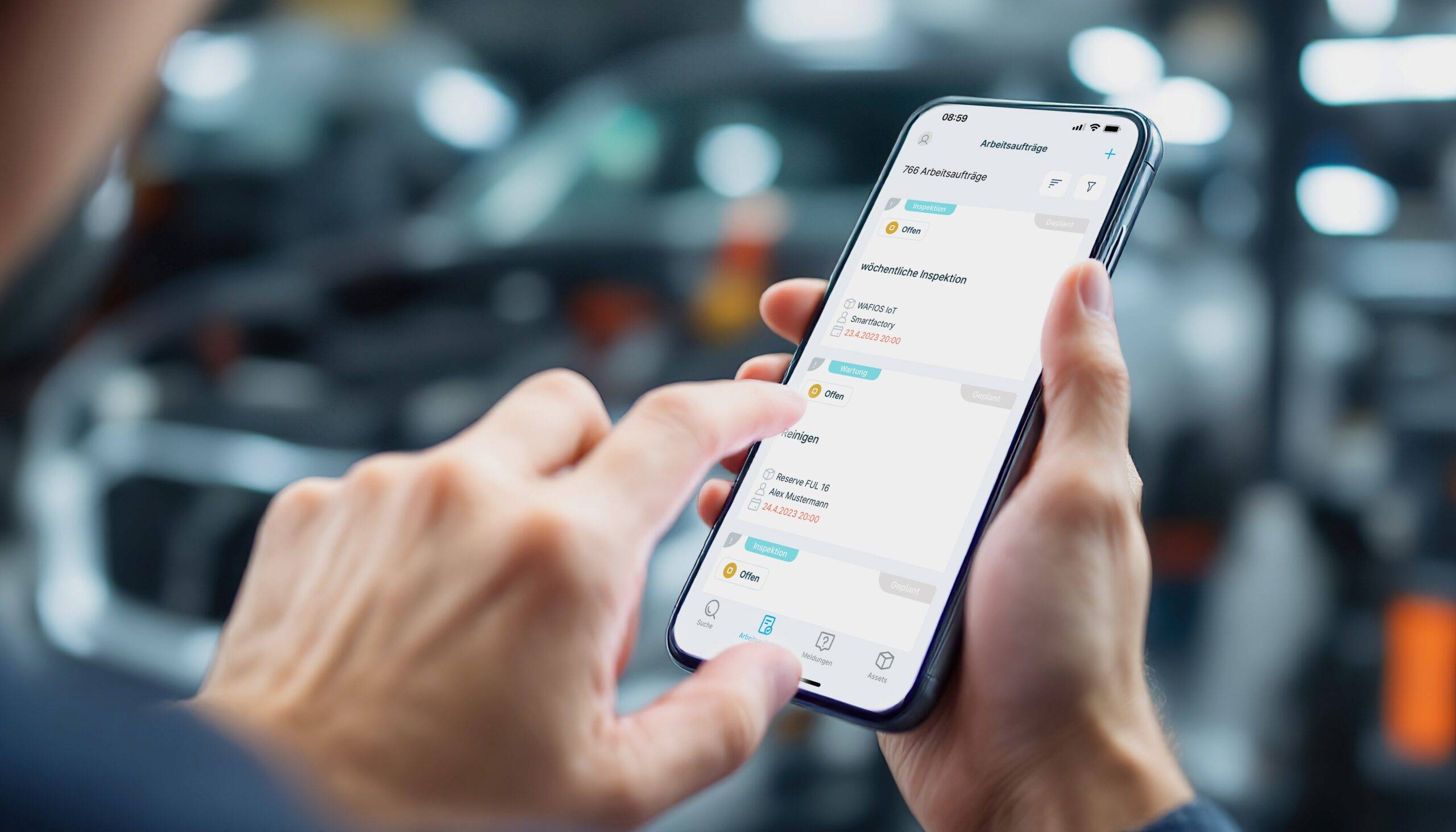
Planned maintenance, one of the eight pillars of TPM, can be directly mapped in connectavo: Maintenance plans, responsibilities, and inspection dates for each system are centrally managed instead of being handled via scattered Excel spreadsheets or paper forms. This transforms paper-based processes into digital maintenance processes, making maintenance predictable rather than random.
This also makes it easier to evaluate your own key figures: Anyone who documents the causes of downtime and the measures taken can establish connections to key figures such as MTTR or identify anomalies early on via condition monitoring before they lead to an unplanned downtime.
Frequently Asked Questions (FAQ)
TPM is a holistic management approach to increasing productivity in production. By involving all employees and preventing downtime and losses, the aim is to achieve the highest possible overall equipment effectiveness.
TPM focuses on the maintenance and availability of equipment, while Lean Management minimizes waste in all areas of the value chain. In practice, both approaches complement each other well.
This depends heavily on company size and starting point. It typically takes several months to years for TPM to be fully established as a concept, as it is a continuous improvement process.
No. The principles can also be applied to administrative areas and service companies, such as facility management, logistics, or purchasing.
Maintenance software primarily represents the pillar of planned maintenance: maintenance plans, tasks and documentation can be managed centrally, thus creating the data basis that is crucial for a successful TPM concept.
Yes, provided that maintenance is consistently organized according to the TPM principle. When predictive maintenance is used in addition to planned and autonomous maintenance, maintenance no longer begins only after a defect occurs. This significantly reduces downtime, and waste in the underlying processes also decreases because there is less scrap and fewer unplanned shutdowns.